If you search online for ways to get high-quality backlinks, you’ll find plenty of information. So in a sense, I wouldn’t have needed to write this post. The reason I’m doing it anyway is that advice on backlinks has often frustrated me personally.
It’s sometimes presented as if it were very easy to get good backlinks and climb to the top of search rankings. But many people follow these tips and still don’t even come close to making it into the top 10 on Google Search. That’s very frustrating. That’s why it was important to me to write a piece on backlinks that sounds a bit more realistic and avoids most of the marketing jargon.
What is a backlink?
It’s easy to explain what a backlink is. You have a website, which we’ll call Website A. Another person also has a website, Website B. If a link appears on Website B that leads to Website A, you’ve earned a backlink.
Backlinks are an important ranking factor for SEO. They indicate how often a page is recommended by other pages. For example, I wouldn’t put a link to another website that I don’t consider worthwhile myself. If I were to link to websites with very low-quality, illegal, or spammy content, that would also damage my reputation.
In the past, the rule was: the more backlinks, the better. As a result, some website owners flooded the internet with links to their sites and were rewarded with high rankings. Eventually, however, search engines realized that this wasn’t a good indicator of quality, and the ranking factors were adjusted. Since then, it has become more important to obtain high-quality backlinks. Five very good backlinks are better than a hundred irrelevant spam backlinks. Spam backlinks could even get you in trouble if they are rated as Black Hat SEO.
What are high-quality backlinks?
Before we look at how to get high-quality backlinks, we first need to understand what that actually means.
Backlinks are high-quality if they
- are relevant to your content
- come from a high-authority site
- have a meaningful anchor text
- appear naturally within a text.
Relevant means that the topic of the other website and its text aligns with your niche. If you have a website with tips for managing asthma, a backlink from the homepage of an auto repair shop is not high-quality.
High authority is difficult to define. It comes down to whether a website has a good reputation, high traffic, and consistently provides helpful content. Wikipedia, for example, would be a site with very high authority. There are some tools, such as those from MOZ or Ahrefs, that calculate a domain authority score. However, you have to be careful here. It is not known exactly how Google defines domain authority.
The Anchor text is the text that contains the clickable link. In the previous sentence, I linked to Wikipedia, and the anchor text was Anchor text (very creative, I know). The anchor text should be relevant to the link, and readers should be able to get a general idea of what the link is about based on the anchor text before clicking on it.
Regarding the last point, it’s important that the link appears naturally within the text and isn’t forced. If I place a link at the very bottom of the page, after the main text, so that this link no longer has anything to do with the content itself, it’s not a particularly high-quality backlink.
Dofollow and Nofollow Backlinks
When it comes to backlinks, we distinguish between dofollow and nofollow backlinks. At first glance, there is no visible difference. To tell them apart, we would need to look at the source code. For a nofollow backlink, the code looks like this: <a href=”https://example.com” rel=”nofollow”>Anchor Text</a>.
Dofollow backlinks influence SEO and search rankings. Nofollow backlinks have no direct influence. They are worthless for SEO. However, that doesn’t mean they are worthless in and of themselves.
Let’s say your website is linked in an article read by 10,000 people. But the link is nofollow. Is the backlink then useless? As far as Google rankings are concerned, initially yes. The link would have no impact on them. However, some of the readers will still click on the link and end up on your website. The more people who click on the link, the more people come into contact with your content, and the higher the chance that one of them will link to your site in turn.
Nofollow backlinks therefore do not play a direct role in SEO or search engine rankings. Indirectly, however, they can be very helpful. So you shouldn’t simply ignore links just because they are nofollow.
Let’s take Wikipedia as an example. The external links (usually at the end of the article) on Wikipedia are nofollow links. They have no direct impact on SEO. However, a link on Wikipedia is, of course, something of a badge of honor for your website. This can draw some readers’ attention to your site.
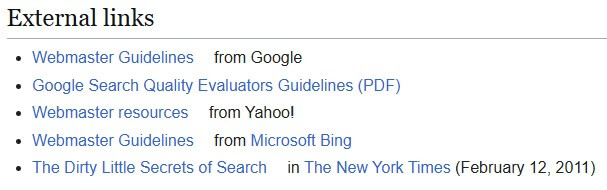
External Links at the end of a wikipedia page
The Dilemma with Backlinks and Rankings
If you look up information about backlinks online, you’ll often find a tip that goes something like this:
Write high-quality content that helps people. Other websites will then be happy to link to it.
This tip isn’t wrong, of course. If you write high-quality content that addresses the user’s search intent and answers all their questions, there’s a better chance that the article will be shared elsewhere and that other websites will link to it. Articles that don’t help anyone, on the other hand, won’t be shared.
However, this is where the dilemma begins, one that is particularly frustrating for beginners. Backlinks are the most important ranking factor. The more high-quality backlinks you have, the higher your chances of a good ranking. But other people usually only find the content if it already has a high ranking. About 97% of all clicks on Google come from the top 10 results. Others can only share good content if they can find it.
Or to put it more succinctly: Good backlinks are important for a good ranking, but without a good ranking, there are few to no backlinks.
I don’t know if anyone has used this term before me, but I call it the Köpenick Dilemma. In the German play The Captain of Köpenick by Carl Zuckmayer, the main character has no residence permit (and therefore no residence) and no job. But without a job, he can’t get a residence permit, and without a residence permit, he can’t get a job.
The advice to write high-quality, helpful content is, of course, still valid. But given the dilemma described above, it’s not quite as simple as it sounds. Building high-quality backlinks requires a great deal of patience and can be very tedious.
Little effort, but little to no effect on SEO
The following methods are relatively simple ways to obtain backlinks. However, these are not really high-quality backlinks.
Comments on blogs
Blogs with a comment function sometimes have a field, in addition to name and email address, where you can enter a website. When the comment is published, this website is then displayed as a link using the entered name as the anchor text.
These links are often nofollow backlinks and therefore have no direct impact on SEO. But even if they are dofollow links, in my experience such links have no effect on rankings. These links have little to no influence, even if the site is a trustworthy one.
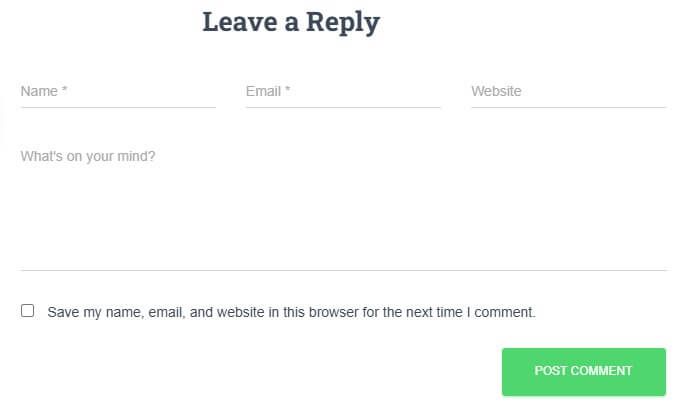
The comments section of this website has a field for the website
Nevertheless, it can be worthwhile to place a backlink this way. If the site has many readers, some of them might notice your link. Or the site operator might notice your website and find it interesting. This could then lead to a “real” backlink in the future. Site operators or administrators often have to approve comments manually.
However, this method is no longer particularly promising today. In the past, when it was all about the sheer number of backlinks, this approach could yield significant results. But those days are long gone.
Posts in Internet Forums
A method similar to the one above is posting links in internet forums. This requires a bit more effort, as you generally can’t just sign up for a forum and then start posting links indiscriminately.
It’s frowned upon when someone joins a forum and then simply posts a link to their website. Such posts may be deleted as spam. If you want to post a link in a forum, start by writing a few helpful posts there and wait a few weeks before adding the link.
However, links of this kind have little to no direct impact on SEO. Even so, a link can still be worthwhile. If the forum is well-trafficked, you can gain a few new readers for your content this way. Of course, the forum should align with your topic. If you have a blog about ice cream flavors and post a link to it in a motorcycle forum, it’s out of place there.
Internet/Website/Blog Directories
This method also requires little effort, but the benefits are minimal as well. Such directories are designed for submitting links. They are often organized by topic. Sometimes you can add a description of the website along with the link.
However, the importance of these directories has declined significantly. Almost everyone now uses search engines like Google or AI to find information online. Directories are rarely visited anymore, which is why their value for SEO is very low.
Especially if you have a new website, it can still be worthwhile to use this method to gather a few initial backlinks, though.
How to get high-quality backlinks
Above, I described three methods for easily obtaining backlinks. However, these methods offer little to no value for SEO and therefore cannot be considered high-quality backlinks. But how can we get such high-quality backlinks? It’s not easy, but below I’ll list three ways to do so.
Broken links
A broken link is a link that points to a page that no longer exists. This can easily happen without the person who set the link even noticing. When I write a post that contains several links to other websites, I don’t constantly check whether those pages still exist.
There are so-called broken link checkers available online for this purpose, such as DrLinkCheck. You simply enter a URL, and the broken link checker checks whether there are any broken links on the page you entered.
Here’s how you can proceed:
- Find a few high-quality websites on a topic you’ve already written about. To do this, enter a few keywords that are also relevant to your website and go through the first ten results in the search results.
- If there are backlinks on that page, use a broken link checker (or check manually if there are only a few links) to see if any of them are broken.
- Check if you have an article of your own that would be a good fit for this backlink. Alternatively, you can write a new article on the topic.
- Send the website owner a polite email and point out the broken link. Ask if they might be interested in adding a link to your content instead. You can often find the website owner’s email address under “Contact” (if there is such a page) or on the privacy policy page.
Guest Posts
Guest posts are another way to potentially obtain high-quality backlinks. Here’s how it usually works: The owner of Website A writes a post that appears on Website B. In exchange, a backlink to Website A appears in the text. Such a post can benefit both parties: one receives high-quality content, and the other receives a high-quality backlink.
Here’s how you can proceed: Search for the keyword “guest post,” where “keyword” is a keyword relevant to your niche. This way, you can find websites that actively offer guest posts.
Another approach is to contact relevant websites (see next point), briefly introduce yourself and your website, and ask if a guest post would be possible. It’s best to suggest a topic or several possible topics right away.
Contacting other website owners directly
Even if there are no broken links or guest posts, it can be worthwhile to offer website operators a link.
To do this, you can follow the steps outlined in Step 1 of the section on broken links. If you don’t find any broken links on a page but believe that one of your pieces of content would be a useful addition to the post, you can send the website owner an email and ask if a backlink would be appropriate.
In my experience, it’s actually quite rare to succeed this way. Most website owners will simply ignore such requests. But all they can do is say no or ignore you. Even if you succeed in just one out of ten cases, you’ve gained a high-quality backlink. The effort was then worth it.
Conclusion
Getting high-quality backlinks has become quite difficult these days. In the past, it was almost entirely about the number of backlinks, and quality hardly mattered. That has changed significantly. Google and other search engines now place much greater value on backlinks from high-quality sites. As a result, the value of simple backlinks—such as those from blog comments or website directories—has also declined.
The easiest way to get high-quality backlinks is through relationships. You won’t be able to avoid reaching out directly to the owners of other websites, introducing yourself politely, and asking about a collaboration. Contacts and relationships are important not only in real life but also in the digital world.
Here’s some advice for beginners. Virtually no one will link to your website if it’s still very small and has very little content. That’s why it’s important to start by creating high-quality content and building a reputation. In the beginning, it can be helpful to focus heavily on social media to build a strong following.
0 Comments